
My DIY Smart Bike Safety System: An Automatic Accident Detection and SOS Alerter
Riding a motorcycle is one of the most freeing experiences, but it comes with inherent risks. As a builder and a rider, I’m always thinking about how technology can make riding safer. What happens if a rider has an accident, especially in a remote area, and can’t call for help?
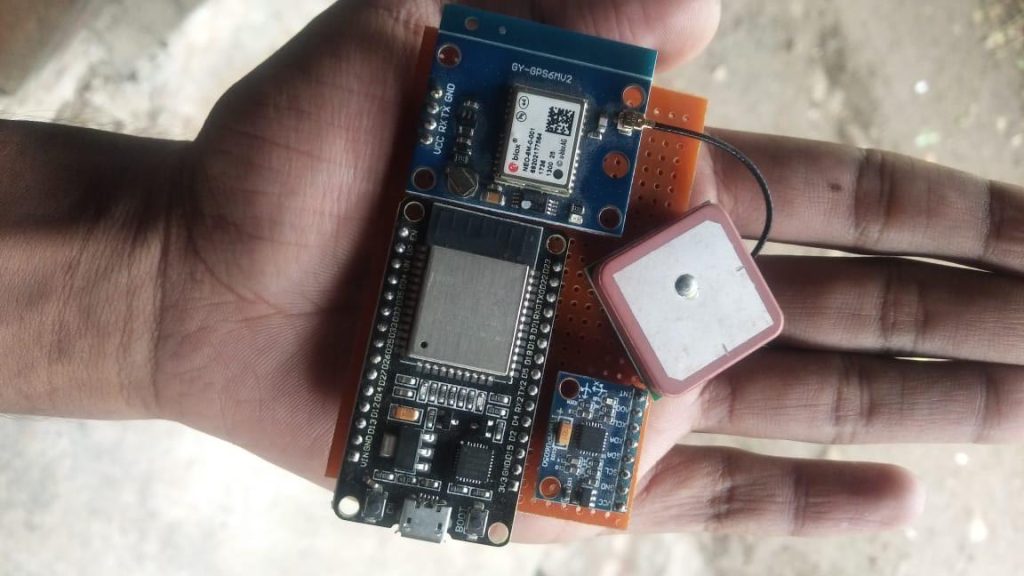
To solve this, I designed and built this compact, ESP32-based Automatic Accident Detection System.
In the unfortunate event of a crash, this device automatically detects the impact and immediately sends an SOS alert—complete with the bike’s exact GPS location—to a pre-saved emergency contact and can be configured to alert nearby services.
The Technology Behind the Build
I built this prototype using four key components, all mounted on a single perfboard:
- The Brain: ESP32This powerful, low-cost microcontroller is the heart of the operation. It has built-in Wi-Fi and Bluetooth, but most importantly, it’s fast enough to process all the incoming sensor data in real-time and make a split-second decision.
- The “Sense” Organ: MPU6050This tiny module is a 6-axis gyroscope and accelerometer. It constantly monitors the bike’s orientation (angle of tilt) and G-forces (sudden impact). My code watches for data patterns that signal a crash—like a sudden, high G-force spike combined with a sharp, sustained tilt angle (meaning the bike is down).
- The Locator: Neo-6M GPSKnowing an accident happened is only half the battle. The Neo-6M GPS module locks onto satellites to get the precise latitude and longitude of the bike at the moment of the crash. Without this, rescuers wouldn’t know where to go.
- The Communicator: A9G (GSM/GPRS Module)This is the device’s voice. Once the ESP32 confirms a crash, it passes the GPS coordinates to the A9G module. This module connects to the cellular network (just like a cell phone) and sends a pre-written SOS text message to a stored emergency number. This message includes the alert and a Google Maps link to the location.
How It All Works: The Emergency Workflow
Here’s the step-by-step process of what happens in an emergency:
- Normal Riding: The MPU6050 is continuously sending orientation and G-force data to the ESP32, which analyzes it and sees that everything is normal.
- Impact Detected: The bike crashes. The MPU6050 registers a massive G-force spike and a tilt angle beyond 70-80 degrees.
- Confirmation: The ESP32’s code confirms these two conditions are met, filtering out false positives (like hitting a pothole or dropping the bike while parked).
- Get Location: The ESP32 immediately requests and stores the current coordinates from the Neo-6M GPS module.
- Send SOS!: The ESP32 commands the A9G module to send the SMS: “ACCIDENT DETECTED! Last known location: [http://maps.google.com/maps?q=LAT,LONG]. Please send help immediately.”
Final Thoughts
This project was a fantastic challenge in hardware integration and real-world problem-solving. It combines sensor fusion, location tracking, and cellular communication into one life-saving device.
The next steps would be to 3D print a rugged, waterproof enclosure for it and perhaps add a small “cancel” button to give the rider 30 seconds to stop a false alarm.
This is a low-cost, open-source solution that could genuinely save a life. Thanks for reading about my build!